
WHAT IS RAM MEMORY?
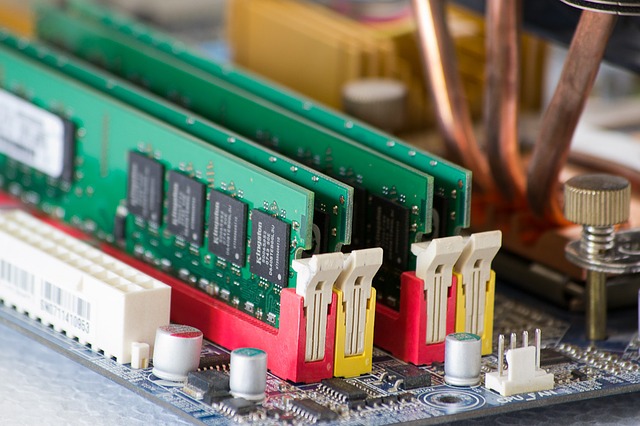
RAM, or "random access memory," is the main memory of a device, where programs and data are stored. Its acronym stands for Random Access Memory, and it's where all the instructions executed by the central processing unit (CPU) and other PC units are loaded.
In 1969, Intel launched one of the first silicon semiconductor-based RAM memories, the 3101 integrated circuit with 64 bits of memory. Later, a 1024-byte DRAM memory, reference 1103, was introduced as the first to be successfully marketed. By the late 1970s, most computers used integrated circuits, which were soldered directly to motherboards or installed in sockets.
RAM or random memory, also known as volatile memory, does not store data permanently; that is, when the power source to the device ceases, the information is lost.
RAM is a large core, filled with ones and zeros, that allows information to be stored and retrieved. It is a semiconductor-based memory that can be read from and written to by both the microprocessor and other hardware devices. It is a type of memory used in all kinds of electronic devices such as computers, mobile phones, laptops, and tablets, and its function is to support the operating system and the processes performed on mobile devices.
RAM is random access memory, meaning that a byte or word can be found directly and easily, without needing to consider the bytes stored before or after it. It allows for both reading and writing information.
RAM (Random Access Memory) helps achieve faster response times when using programs on a computer, as the information the program needs to run is stored in RAM. This means that when a program is executed, all the necessary instructions are transferred to the processor, with data being transmitted as needed. Both RAM and the processor connect to each other to exchange the requested data.
RAM stores this information and sends the data that needs to be processed to the processor; therefore, the higher the transmission speed and storage capacity of the memory, the more programs the user can run simultaneously and more quickly.
RAM, the essential element for multitasking
If we open many programs on a device, the RAM will need to load the instructions for all of them. Depending on the RAM capacity, we can open more or fewer programs simultaneously.
RAM (Random Access Memory) is an electronic device capable of temporarily storing instructions and data, but it loses the data when the computer is turned off. The main advantage of RAM is its high speed when transmitting information. The more gigabytes (GB) the RAM has, the faster it will be and the more benefits it will offer. With faster transmission speeds and greater storage capacity, the user can run more programs simultaneously and more quickly.