

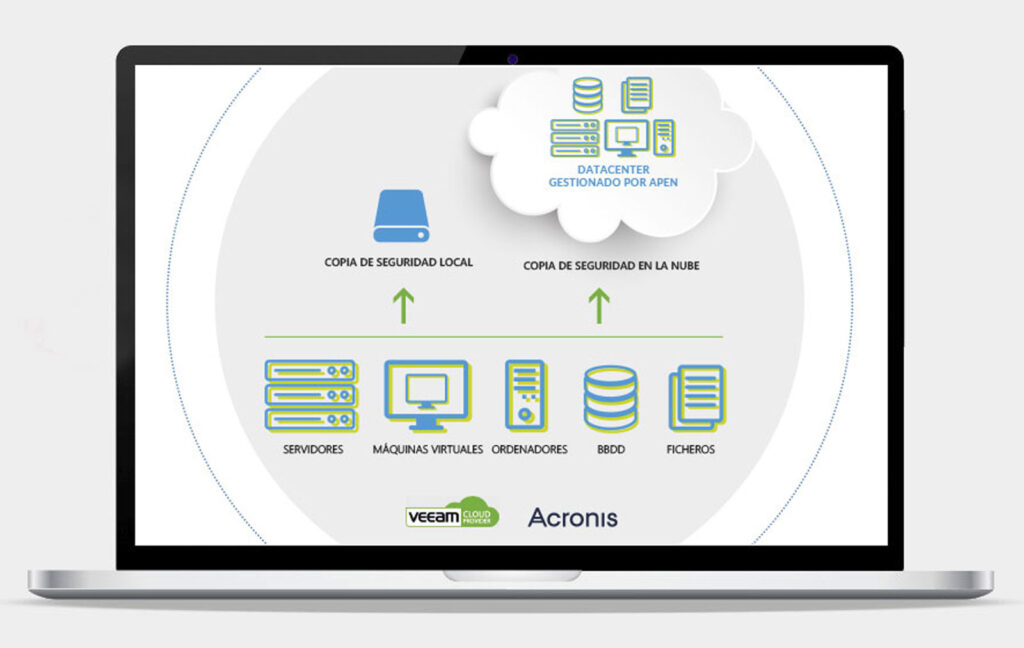
Cloud backup is the safest option to protect a company's data, achieving encrypted data processing, with up to 30 stored versions and compliance with GDPR regulations.
With the CLOUD backups You will have a monitored and fully programmable system, taking into account your preferences and business needs, and the possibility of retrieving your data remotely, if necessary.
The CLOUD backups They represent a comprehensive and highly secure system that is also very affordable, because it adapts to the client's spending level through a "pay-per-use" model, eliminating software and physical space costs and only paying for what is used, without additional costs.
A data protection system made available to SMEs, to copy entire servers and achieve effective and efficient system restoration solutions in the shortest time and with the highest security guarantee.
The increase in cyberattacks has made evident the need for security systems that protect companies with complete guarantees; that's why it's important to have CLOUD backups, To create a duplicate of the system and store all the data of the SME, performing a migration of the recovery disk through cloning and mirror images.
The CLOUD backups They allow you to store and access company data from any device, synchronizing or backing up files and folders to the cloud. In fact, they also allow for quick and easy system recovery, or the recovery of a specific file or folder.
Cloud backup allows you to protect any environment and is completely reliable, fast, and efficient, with customizable backup scheduling according to your desired schedule and frequency, whether monthly, daily, weekly, hourly, every 10 minutes, etc.
These are incremental backups, meaning the first backup will be complete, and subsequent backups will only transfer the files you've changed. This allows for flexible restoration of data and/or entire systems in just seconds from cloud storage.
Having company data readily available and the ability to restore from a backup is essential, which is why it's advisable to have backups. This allows for simple and scalable data management, and even enables you to track the status of backups in terms of size, speed, and more.