
Our news
The 3-2-1 rule for backup
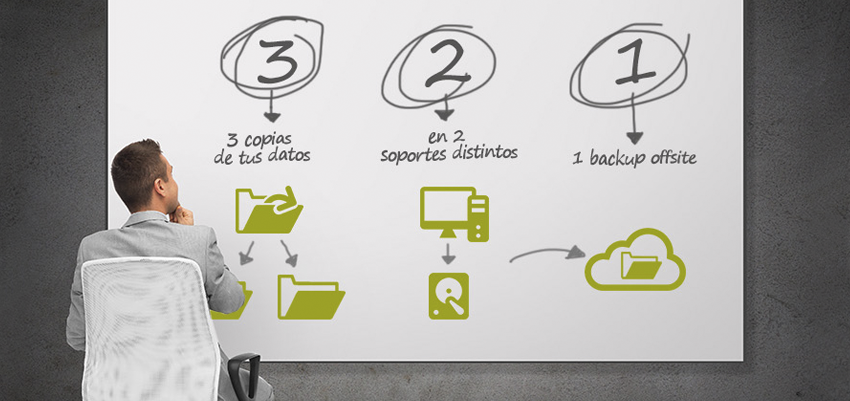
We've all lost a file, image, or folder containing important information at some point due to human error, hardware failure, viruses, or natural disasters. In this post Apen It explains how to prevent these types of situations by applying the 3-2-1 rule, based on performing 3 copies of our data on 2 different media and store one of these copies in 1 different physical location.
3 copies of your data
We need to create 3 backups of our sensitive data, ideally daily. By 3 copies we mean having the original file plus 2 backups. Just 1 copy is not enough, because, statistically speaking, more copies mean less chance of losing your files.
Let's assume we have the copies on two separate media, media A and media B. If each of them has a probability of failure of 1 in 100 times, the probability of both failing simultaneously is 1 in 10,000 times. If we add a third media (A+B+C), the probability of failure decreases to 1 in 1,000,000 times.
2 different supports
It is very important to store the copies in 2 different supports (local disk, network disk, USB, SD card, CD, DVD, and/or other media) since each medium has its advantages and disadvantages. If we have the 3 copies on two identical media, it's possible that, in case of failure, the same malfunction will affect both devices equally.
To avoid this, the rule 3-2-1 It is recommended to keep copies of your data on at least two different media: for example, a hard drive and a DVD. This will minimize risks.
1 offsite backup copy
The third indispensable piece of the rule 3-2-1 It's the physical separation of the data, what we technically call an offsite backup. Save the third copy in 1 different building It is a very important measure to prevent all data from being lost in case of theft, fire or any other catastrophe.
In this sense, a very practical alternative is to store the third copy in the cloud.
Implement and monitor the rule 3-2-1 It may seem complicated, but much worse is the irreparable loss of our company's important data.