
WHAT IS AN ERP?
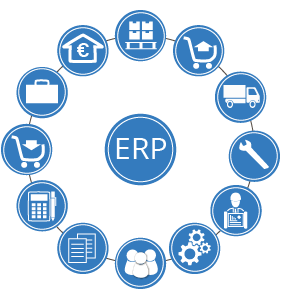
When we refer to ERP, we mean Enterprise Resource Planning. ERP is an internal program for production, distribution, and human resources within a company; in other words, a program that centralizes all of the company's activities.
ERP is also known as “back office”, which deals with internal administrative matters, or “front office”, which performs operations related to customer service.
For an ERP to be considered as such, it must fulfill these requirements: it must be comprehensive (manage all aspects of the company), modular (divide according to the company's departments) and adaptable (adapt to the company's activity)
The purpose of this program or software is to help the company's clients by solving their problems in the shortest possible time, as well as managing all the information to make good decisions.
ERP CREATION
In 1990, Gartner, a technology research and consulting firm, coined the term ERP to address an increasingly common need in businesses., increase productivity and optimize time. Starting from 2000 With the introduction of the euro, companies saw an opportunity to adopt the ERP system, leaving behind old practices, since entering a new era brought new problems that only an improved system could solve.
ERP MODULES
Human resources module: It assists in the hiring of new employees and also tracks employee performance. With this module, employees can view and verify hours worked, manage leave requests, process payroll, and send surveys or news of interest to encourage employee engagement.
Inventory module: It handles the buying and selling process. It tracks inventory, generates unit reports, and locates items in the warehouse.
Purchasing module: It handles all aspects of product and raw material procurement. With this module, you can create a list of suppliers, items, analyze budgets, generate purchase orders, track items, and update inventory.
Sales module: Includes reporting and analysis, order acceptance, and invoice generation.
Financial module: Automate and simplify the entire accounting process, thereby reducing potential errors and costs.
Production module: It facilitates production tracking, raw material control, and product quality assessment.
Customer Relationship Management (CRM) module: This module significantly increases sales by improving customer relationships. This tool allows you to gather customer information so that you can provide personalized and tailored service.